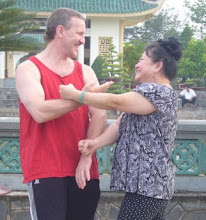
The guys are students of Allan Fong, one of GM Leung Ting's earliest students from Hong Kong. Notice the progression from Lap Sau to freehand chi sau.
Friday, May 7, 2010


Lap Sau Series No. 5
Henning is one of the best WT fighters, but here he shows it nice and slow. Notice how most of what he does is based on the Lap Sau cycle (bong/fook/tsuen sequence):
Lap Sau Series No. 6
Selected parts of the whole student program in one piece, from Daan Chi to 7th section Chum Kiu chi sau and even bits of Biu Tze. Keep paying attention and focus on the bong sau/lap sau/tsuen sau cycle.
This video has embedding disabled, so you have to click the link to see it. It will open in a new window.
http://www.youtube.com/watch?v=dXN8YuetRwY&feature=related
This video has embedding disabled, so you have to click the link to see it. It will open in a new window.
http://www.youtube.com/watch?v=dXN8YuetRwY&feature=related
Sunday, March 14, 2010
Do You REALLY Want to Learn Wing Tsun?
Houston's Wing Tsun Backyard is open to anyone - but not everyone will make it through the door. You can apply to join, but whether or not you are accepted as a students is up to you.
A very wise Sifu recently told me that "students do not choose Wing Tsun, Wing Tsun chooses them". That opened my eyes. Wing Tsun is not for everyone. Whether it is for you is for you to find out.
As before, anyone can come and watch a class or participate in a free introductory class. After that, if you decide to start, you will be on perpetual "probation".
I have decided to stop trying to convince students to take their training seriously. Now, it is the other way around. If you want to train here - and continue to train here, you have to convince me - and yourself, of course - that you are serious.
If I notice that you do not practice at home what I teach you in class, you will have a chance to correct that - but if you don't, I suggest looking for another Wing Tsun school that considers itself to be a service provider. This one is not. You don't pay for a "service" here. You pay for the right to learn and practice. Nothing else.
If you still want to schedule a free intro lesson, feel free to call me at 832-452-9966. Classes are held at 4341 Polk St., Houston, TX 77023 on Tuesdays and Thursdays from 6:30 pm to 8:30 pm.
All the Best,
Alex Wallenwein
Owner, Instructor
Houston's 'Backyard' Wing Tsun School
PS: If you want to know about my background in Wing Tsun, I have practiced WT since 1981. My Sifu is EWTO founder and Grandmaster Keith Kernspecht in Germany, but I only met him twice in my WT career. My first teacher was Si-Hing Curtis Dittrich. I learned directly from GGM Leung Ting and from my Dai-Sihings, Sifu Thomas Dolnitzki (who sadly recently died) and Sifu Emin Boztepe. I have the certificate for only a "Primary Level Technician" under the Leung Ting system (since 1985), but I know more than that. I'm just not interested in titles and certificates. If you are, this may not be the right place for you. How much more I know is for you to find out. I also am no longer a member of any Wing Tsun organization. I left the Leung Ting organization in 2005. If you want to know more, just ask me. I am not secretive - but I also don't embellish the truth.
Monday, February 22, 2010
JOIN THE TEXAS CHI SAU CIRCLE!

Do you live in or near Texas? Do you practice Wing Tsun/Wing Chun/Ving Tsun (or whatever) and need "chi sau" partners to work with? This new Facebook group is your ticket.
The idea is to let potential training partners find each other - regardless of what school, organization, or association you come from, and regardless of any false loyalties that only hinder your training progress.
If you worry that your instructor may get angry at you for participating, tell him that through your connection with the Texas Chi Sau Circle you will be able to advertise for his future seminars and expose his school to more students from his area - for free. The only condition is that seminars be open to all systems or schools of wing chun/tsun etc. There must be no requirements to join any school or organization in order to participate.
As we grow, we can also hold "cross-denominational" summer (or better spring and fall) ving tsun training camps (this is Texas, after all). You can start discussions about wing chun-related topics on the discussion board and share photos, videos, and events. But, most importantly, you can find training partners right where you live.
Wing Tsun is all about adaptability, isn't it? So, why practice chi sau only with people from your own school or organization? How do you know your stuff works against people from other systems? This is your chance to find out. All it takes is a certain independence of mind and spirit (a prerequisite for learning wing tsun, at any rate), and the determination to get better, no matter what.
We are looking forward to seeing you join. If you don't live in or near Texas, you can start your own Wing Chun Chi Sau Circle wherever you are. It's easy - and it's free, whether on Facebook or elsewhere.
Welcome!
Alex Wallenwein
Sunday, November 1, 2009
Wing Tsun Philosophy: A FIST IS A FIST!
Huh??
What kind of philosophy is that? Where is the esoteric wisdom? Where are the flowery words? What's the meaning of this?
Wing Tsun philosophy is a fighting philosophy. As such, it had better deal with reality - and a fist in your face (or very quickly coming at it) is the ultimate reality you'd better learn to contend with in Wing Tsun, or else all of your training is a waste of time.
In light of that, this simple statement - a fist is a fist - takes on new meaning. Forget about all of the flowery BS. Focus on reality, not ephemeral concepts.
SO, what'is the first reality you encounter in WT?
It's you.
You, your arms, your legs, the rest of your body, your mind, your breathing, your physical and mental strengths and limitations, and how it all relates to every other part - and, finally, how it all works together.
Learning to deal with all of that is the first stage of your development in WT - and that is what the first form of Wing Tsun, Siu Nim Tau, is there for.
At the Siu Nim Tau stage of your training, you become acquainted with and then learn to face - yourself.
Tadaa!
It's you, my friend, with all of your inner tensions, imbalances, your breathing and thinking habits, and the limitations of your perception of yourself.
Your instructor is telling you to do something you are unfamiliar with, you feel goofy as hell doing it, and then, on top of all that, he keps telling you that you're doing it wrong and "corrects" you in ways that you can't even figure out the difference between "wrong" and "correct" at first.
Welcome to the whacky world of Wing Tsun. At this stage, it's all about you, these weird new movements, arm, and leg positions you are learning, and how to let them slowly, through endless repetitions it seems, become a part of you. Rule No. 1: you must become what you do.
But there is more.
Unless you are Jim Carey in the movie "Liar Liar" as he is "kicking his own ass" as he puts it during the famous bathroom scene, you must learn to deal with an opponent, as well. So, while you are learning to battle yourself, you are introduced to all of the things an attacker can do to you as you try to assimilate these new movements you have just learned.
After you learn to execute the defensive arm movements solo, you find out that they are not really movements you do. They are movements your attacker is making you do by virtue of the power, position, and angle of his attacks. You learn that (almost) all of the defensive movements in WT are really nothing than frustrated attacks. That's why the Wing Tsun motto goes,
"When the way is free, punch (or kick, knee, elbow, or whatever). If something (an arm of leg of your attacker) interferes with your attack - stick to it with your own arm or leg. If he forces your arm or leg to retreat or bend - yield. If he suddenly retracts his attacking limb to launch a second attack - follow him while continuing to stick to him. Finally, as the way is free again - attack!"
Attack, stick, yield, follow - and attack again.
Of course, "attack" isn't first among these for no reason. It is always the first thing you do when you are threatened. If it isn't, you will always draw the shorter straw in the game. Your opponent wil always get the jump on you and he will have eall the leisure in the world to regoup and attack again and again, unless you give him something to worry about - and that is your attack. The squence above can be cut short at any stage. If at any moment the way is freed again, attack! It makes no difference whether that hapens while you "stick", "yield", or "follow". Whenever the way is free, attack!
In a fight, all of this happens in split seconds, without time to think. That's why you need to repeat, repeat, repeat, until not only the movement but the response to an attacking stimulus becomes automatic. There are endless variations of this scenario, and each variation has its own natural response. In fact, each variation has several possible responses, and by repetition you train your body, your nervous system, and your mind how to deal with them instantly, without hesitation, and without second-guessing. That phase and process of your training is called "Chi Sau", or "Clinging Arms".
In time (not too much time, but it does take some), you will find out that it becomes harder and harder to fake you out. You no longer care if an attack is real or fake. You respond to it the same way - by attacking yourself, and in such a way that your attack intercepts and neutralizes your opponent's attack.
At this stage, you become what your opponent does. Your opponent's attacks and your defenses and counters become one. Without his attack, there would be no response, and the way in which he attacks determines your response. There is no time for mistakes. There is no time for thinking. There is no time for deceiving yourself about how much you know or how dangerous you are - or even about how much your attacker knows and how dangerous he is. You learn to see things how they really are, not how you would like them to be or how you fear they might be. In other words:
Reality.
A fist is a fist!
This is the ultimate reality in any fighting art - and Wing Tsun teaches you how to confront and become one with this reality like no other art does.
That is the philosophy of Wing Tsun.
Alex Wallenwein
Subscribe to:
Posts (Atom)